Showing posts with label Demo. Show all posts

Tuesday, February 28, 2012

Why Recording Matters

One of the realities of the music industry is that you can't rely on anyone else's imagination to fill in any recording quality deficiencies. As some would say, you almost have to spoon feed your song to the listener.

Consider this scenario: you have written a great song and used GarageBand or your cell phone to record a rough work tape. You march into a publisher's office and tell them you've created the best thing since sliced bread. They turn the speakers up, hit "play", then hit "stop" 30 seconds in. They didn't even make it to the chorus. Instead, they take out your CD and pop in a song from another writer that they're excited about. What comes through the speakers may sound better to the ears, due to the fact that the song was recorded well in ProTools or Logic. But deep down you know that your song was better than the one the publisher enjoys listening to.

How do you avoid a scenario like the one above, where a worse song gets attention because it sounds better? Focus on getting a great, clean home recording. If you track even just a piano/guitar and vocal well, you could even use those recordings as the foundation for a full-band track.

If you're interested in taking the next step in setting up your home studio, I would highly recommend picking up a copy of Mike Senior's Mixing Secrets for the Small Studio. It has helped me take very practical steps in improving my own setup, and I'm sure you would benefit as well.

Keep writing,
Ben


------

Would you or someone you know like to go on a songwriting retreat with industry professionals? Visit SongbirdCamp.com for more details!

Sunday, January 30, 2011

Fast - Cheap - Good: Pick Two

Here's a marketing tool that I've found helpful: in any given project, a product can be fast, cheap, and/or good. But it can only be two of the three. Let's look at this through the lens of a songwriter.

If you're interested in getting a song recorded, there are three scenarios:

Fast Cheap Good1. Fast/Cheap

There's an audio engineer friend who is looking for some recording experience. He said he'd record your song at his place if you buy him lunch. Fast and cheap, but what level of quality should be expected?

2. Cheap/Good

There's a family friend who has had success over the years recording well-known artists. As a favor, he offered you the opportunity to come into his studio when it's available to record some songs. He even said he'd be willing to mix them. It's no cost, and the quality is top-notch. But how long will it be before he has a free day to mix your song?

3. Fast/Good

There's a professional audio engineer in town who has gained a reputation for not only getting great-quality recordings, but mixing them the very next day. Nothing's better to a songwriter or publisher than getting a final mix so soon, but how much is that going to cost?

The best audio engineer of all is the one who makes you feel like you got a recording that was all three of the above: cheap, good and fast. It's your job to figure out which one of the three it's not!

Keep writing,

Ben

Saturday, January 8, 2011

Cliff Goldmacher - Before You Demo Your Song


Here are some very helpful tips from fellow songwriter Cliff Goldmacher about how to prepare for a demo recording session. It's essential to prepare so that the studio experience is fun and enjoyable instead of stressful. That way everyone is most capable of doing their best work!

Keep writing,

Ben

Thursday, December 16, 2010

From the Writing Room to the Studio

I had someone ask me recently, "How does a song get from the writing room to the radio?" Well, the most important step in that process is the song's transition into the studio. In my experience, only about one in every 8-10 songs written makes it from the lower-quality GarageBand version to the full-band studio version.

Here's an example of a song that made the jump from the writing room to the studio:


          "Breakthrough" (Ben Cooper/Jenn Schott) ©2010

          Exhibit A - Writing room version, immediately after finishing the song (Jenn singing):


          Exhibit B - The full-band demo recording (artist Mallory Hope singing):


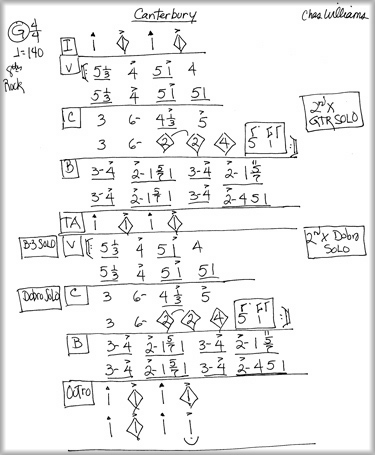
In the course of three hours (the length of each "session"), a band of musicians will usually record five songs. Broken down, that's a song every 40-45 minutes, at a quality that sounds like something you could hear on the radio. The way this proficiency is accomplished is by having the songs mapped out ahead of time by the session's lead musician (here is an example of a chart written using the Nashville Number System).

When the time comes to begin recording the next song on a session, the players all congregate in the mixing room to hear the songwriters' rough recording (Exhibit A). They follow along on the charted road map, jotting notes along the way. After hearing the song only one time, the players take their places in the soundproofed tracking room and run through the tune. Then after a little banter about who should take the solo and when and where each player should come in, they play through the song for the final pass (Exhibit B). Generally the final demo version of a song is literally only the second time these players have ever attempted the song! After the band's tracking session, a demo singer or artist will come in and overdub the final vocal, and the engineer will mix the songs, sometimes even the same day.

These session players and singers are some of the most talented individuals I have ever been around. I wish I could bring everyone into the studio on days that we are recording, because it is such an amazing process to see. I believe that the most "Nashville" thing that a tourist could ever experience is not walking down Broadway through honky-tonk bars, but rather sitting in a studio while a song comes to life before their ears. And this is an experience that I hope you are all able to have someday soon.

Keep writing,

Ben